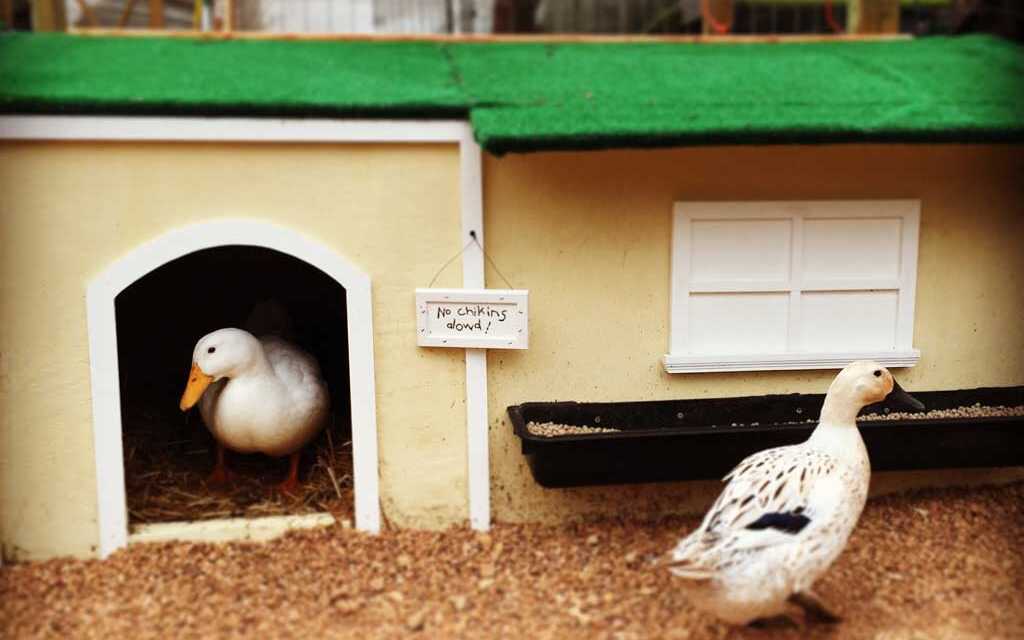
Which Nest Box or Shelter to Choose for Your Duck?
Regardless of the breed you have chosen—mallard duck, Indian runner duck, Muscovy duck, or others—these backyard animals need quite a bit of space to exercise properly. You should provide at least 2 to 5 m² of space per animal.
To prevent predators and escape, they need a fenced shelter. A fence about 1.50 m high will prevent them from wandering elsewhere. Ducks also need a house to rest and lay eggs. Therefore, you need to set up a comfortable duck shelter. Which nest box or shelter should you choose for your duck?
Duck House
Generally, ducks are birds that love to live outdoors in the open air. However, it is important to set up shelters or nest boxes for your domestic ducks.
They need them for sleeping as well as for laying eggs. You can choose from several types of shelters or nest boxes for mallard ducks, Indian runner ducks, Muscovy ducks, etc.
The Different Types of Shelters or Nest Boxes for Ducks
Ducks could do without a shelter, but at night they risk falling victim to pests. Therefore, providing them with shelters becomes important.
- The Duck Cabin
The duck cabin should be designed to protect your ducks from rats, which are predators of ducklings. The walls can be made of 10 cm thick cinder blocks. It is essential to build several rows to provide enough space for your Indian runner ducks, mallards, Muscovy ducks, etc., to be comfortable.
However, a four-row cabin is sufficient. For the roof, choose fiber cement sheets that must be securely fastened. Avoid metal sheets. Do not forget to seal the gaps caused by the corrugated sheets. The openings of the cabin should be oriented towards the east.
You can also plant vegetation to protect the cabin from cold winds if you live in a colder climate. Regarding the slope of the cabin, it should be directed towards prevailing rain patterns. Inside, add a good straw bedding. Most importantly, do not forget to install a door to close the cabin.
- The Duck Enclosure
To set up a duck enclosure, you need at least 200 m² of space, preferably a grassy area. Your mallard ducks, Muscovy ducks, Indian runner ducks, and others should have access to grass, worms, slugs, etc. The enclosure should have a fence at least 1 m high.
The fence mesh should be fine enough to prevent ducklings from escaping. Bury the bottom of the fence about 5 cm deep. Your ducks must have plenty of water for drinking and bathing.
You can even provide a natural pond or build a concrete pool with minimum dimensions of 3 m long, 1.50 m wide, and 0.30 m deep. Include all necessary elements in this enclosure to create an ideal environment for your ducks.
- The Maze Nest Box
The maze nest box is the most commonly used for breeding wildfowl. It is made of wood and marine plywood, which is ideal as it is rot-resistant. It is used during the duck breeding season.
For installation, position it facing east, against prevailing winds, cover it with branches and other foliage, place a thin layer of soil at the bottom of the maze nest box, add anti-parasite mixed with the soil, choose hay instead of straw, and leave the nest undisturbed.
If you have a large number of maze nest boxes, you can number them to stay organized during hatching.
- The Duck Park
The duck park is an ideal place for mallard ducks, Muscovy ducks, Indian runner ducks, and others. With this type of shelter, they have access to a large space for entertainment.
The duck park should include a cabin, which can be made of wood, nest boxes, and a water basin of sufficient size to allow the ducks to bathe properly. Inside the cabin, ducks should have a water corner (pond) with a minimum depth of 1 m. The park should be well-fenced with a mesh that prevents your ducks from escaping.
- The Duck Cage
Generally small, the duck cage is not ideal for ducks. Placed on the ground, made of wood or wire mesh, without bedding or solid flooring, the duck will have difficulty resting. Consisting only of a waterer, the duck cage is completely bare.
When confined in a cage, ducks develop abnormal locomotion, wing wounds, and leg injuries. Therefore, avoid using a duck cage as a shelter for your ducks.
Building a Floating Duck Nest Box
For building a floating duck nest box, it is recommended to use rot-resistant wood. This will allow you to reuse the nest box season after season. Gather wood, screws or nails, a screwdriver or hammer, and a saw or circular saw.
For installation, position the entrance of the floating duck nest box opposite the prevailing winds. Place high-quality hay inside to help the female duck build her nest.
Homemade Duck Nest Box
To build a homemade nest box, you will need several tools, including screws, a screwdriver or nails and a hammer, a jigsaw or circular saw, a ruler, a square, a pencil, and a measuring tape.
You will also need wood—marine plywood (or formwork wood) is ideal as it is rot-resistant. You can also use reclaimed wood, such as standard plywood or particle board if available. You can choose the plan that seems most suitable.
First, cut the wood, then proceed with the assembly. Ensure the screws are well tightened. You can choose the nest box dimensions based on the size of your female duck.
Buying a Duck Nest Box
The price of a nest box depends on several criteria. The cost varies based on size, material, and color. Since quality goes hand in hand with price, it is advisable to opt for a high-quality nest box that will last for several years.