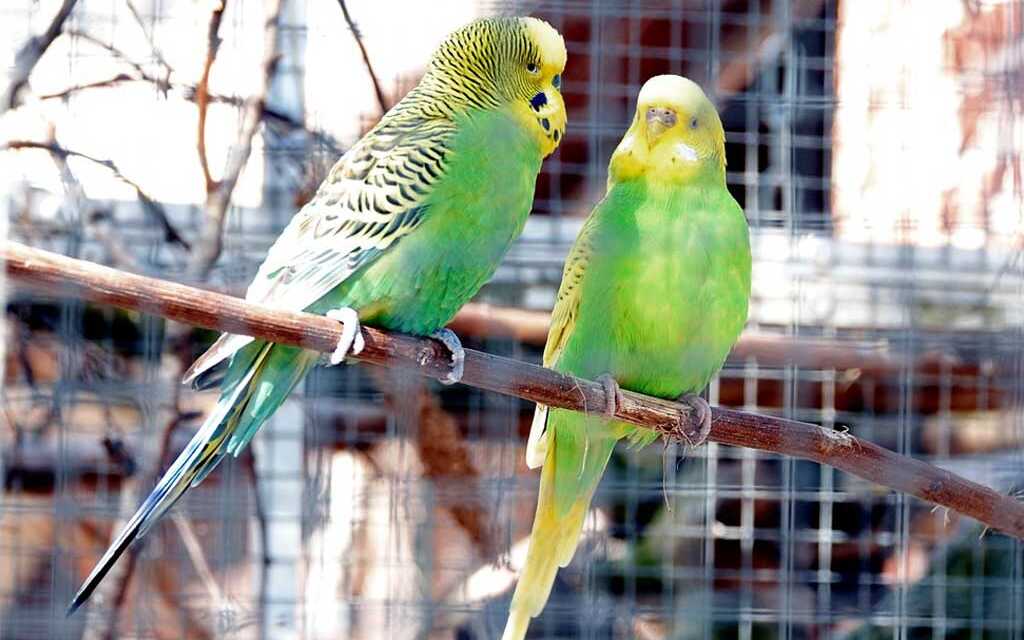
Whatever the type or breed of bird you have decided to tame, be aware that these animals have a morphology and biology adapted to physical exercise, meaning flying and movement.
For these birds—parakeets, parrots, and others—the need for vital space, the ability to fly, and the possibility to move are essential elements for their well-being. Your parakeet, regardless of its breed, needs a living space adapted to its wingspan and its psychological and physical need to fly.
You therefore need to provide it with a cage or an aviary that will allow it to have an excellent life while being tamed. Which cage or aviary should I choose for my parakeet?
The breeding cage for parakeets
The cage is the residence of your parakeet. It spends its entire day in this space. It is its area for leisure, food, and more. This cage therefore needs to be of a size that meets all its daily needs.
There are several breeds of parakeets. These parakeet species sometimes do not have the same lifestyle or size. A cage for a large parakeet must be spacious to allow it to move freely.
A large parakeet cage allows us to provide everything necessary for our parakeet, given the space it offers. So, you need to set up a cage that matches the various characteristics of your parakeet.
- Budgerigar cage
The budgerigar is a sociable breed of parakeet. This type of bird needs to live in a group of 2 to 10, sometimes more, to satisfy their social needs. It is true that budgerigars are small in size.
However, it is also important to know that these birds are capable of traveling hundreds of kilometers in a single day. For a pair, you can opt for a 1 m³ cage. If you intend to have more budgerigars (6 to 10 individuals maximum), then choose an aviary.
If you often take your budgerigar outside from time to time, then you can opt for a cage that is 80 cm long, 80 cm high, and 50 cm wide. This should be sufficient for a pair.
- Cockatiel cage
Cockatiels are large bird species in adulthood. Therefore, they require a cage with different dimensions than budgerigars. Even if you are used to letting them out daily, they still need a cage that allows them to move properly and stretch their wings.
For a pair of cockatiels, a cage measuring 150 cm long, 80 cm high, and 80 cm wide would be suitable. However, for 4 to 5 individuals, you will need a cage that is 1 m to 1.2 m in length, 80 cm wide, and 1 m high. To better accommodate your cockatiels, you might prefer an aviary.
The outdoor parakeet aviary
Setting up an aviary for your parakeet involves considering several factors, including the number of birds to tame, your budget, the available outdoor space, the weather, the opinions of family members and neighbors, and a warm, sheltered space for the parakeets to withstand winter conditions.
It is also important to check local regulations and contracts to ensure there are no issues regarding noise pollution from the aviary or construction permits. You can build an aviary using wood, plastic, or non-oxidizable metal.
You can create foundations with cement or rubble, with a concrete floor above. This will make maintenance easier and keep the birds safe from muddy and infected grounds as well as microbes. Adding gravel or sawdust to the floor and planting small trees in the aviary can make the space more enjoyable for your parakeets.
What are the dimensions for indoor and outdoor parakeets?
The dimensions of an indoor or outdoor parakeet enclosure depend on the number of birds and their size. For a pair of budgerigars, an aviary measuring 2 m long, 1 m wide, and 2 m high would be ideal.
The outdoor aviary for a cockatiel varies depending on the number of individuals. For 4 to 8 birds, you will need an aviary that is 2 m wide, 2 to 3 m long, and 2 m high. Beyond this number, your outdoor aviary should be at least 6.4 m long, 3.4 m wide, and 2.6 m high.
The indoor aviary for a parakeet also depends on the number of individuals. For 4 to 8 birds maximum, you should set up an indoor aviary that is 2 m long, 2 m wide, and 2 m high. If you have more than 8 birds, you should increase the length to 3 m, keeping the width at 2 m and the height at 2 m.
Keeping parakeets warm outdoors
When you decide to keep your parakeets in an outdoor aviary, you must plan for heating during winter months. However, avoid using additional heaters. Several options are available to ensure your birds are kept warm.
Insulate the interior of the outdoor aviary, and ensure the boiler cover is completely waterproof. Follow the same insulation principles as a house when designing your outdoor aviary.
This means constructing walls with a small space between the inner and outer walls. Parakeets dislike drafts, even in warm weather. They need a space that protects them from weather conditions.
Avoid using open fireplaces, domestic gas or electric heaters, camping stoves, etc., in the outdoor aviary. Instead, you can use special aviary heating lamps—one or two 120-watt bulbs. Always check the bulbs to ensure they are functioning properly.
Why choose a standing cage for a parakeet?
Having a standing cage for a parakeet offers several advantages. Often equipped with wheels, it is extremely easy to move. For large parakeet cages, it is a great option.
A detachable cage allows you to dismantle and store it if you no longer need it. Very aesthetic, this type of cage is available in various sizes, from small to large.
Affordable parakeet cage
The price of a parakeet cage depends on several criteria. The price varies according to the dimensions and materials. Parakeet cages made of wood, aluminum metal, or plastic do not have the same price.